

A prominent son of the Uzbek people, the charming poet, playwright, great scholar, and critic Hamid Olimjon left an immortal legacy. He is a poet who created a school of poetry based on vibrant lyricism in Uzbek poetry.
A talented poet, playwright, translator, literary critic and folklore scholar, statesman and public figure, Hamid Olimjon was born on December 12, 1909 in the city of Jizzakh. After graduating from the Narimonov primary school, he studied at the Samarkand Pedagogical Institute (1923-1926) and the Uzbek Pedagogical Academy (1926-1931).
Hamid Olimjon began writing poetry during his student years. His works began to appear in the newspaper “Zarafshon” in 1926. In 1927, the poet joined the editorial staff of this newspaper. Hamid Olimjon’s first collection of poems, “Ko’klam”, was published in 1929. After that, such collections of poems as “Fire Hair” (1931), “Death to the Wild” (1932), and “Race” (1932) were published.
Corresponding member of the Academy of Sciences of Uzbekistan (1943), Hamid Olimjon created a number of scientific and critical works on current issues of Uzbek literature. He translated the works of A. Pushkin, L. Tolstoy, M. Gorky, V. Mayakovsky, A. Serafimovich, T. Shevchenko, M. Lermontov, N. Ostrovsky, A. Korneychuk and wrote articles about them.
The epic poem “Alpomish”, a magnificent masterpiece of Uzbek folk art, was first prepared for publication by Hamid Olimjon and published with a preface (1938). As a member of the committee for the celebration of the 500th anniversary of Alisher Navoi, he conducted research on the life and work of the great poet. From 1939 to 1944, when he died in a car accident, he headed the Writers’ Union of Uzbekistan.
The poet glorified the progressive ideas of his time with his collections “Daryo Kechasi” (1936), “On the Shores of Chirchik” (1937), “O’lka” (1939), “Bakht” (1940), “The Story of Two Girls” (1935-1937), “Oygul and Bakhtiyor” (1937), “Zaynab and Amon” (1938), and “Semurg” (1939).
During the fiery years of World War II, his poetic drama “Mukanna” was created, which still remains a masterpiece of our dramaturgy. Many of the works of the talented poet Hamid Olimjon have been translated into the languages of fraternal peoples and foreign nations.
Khurshid DAVRON Library.
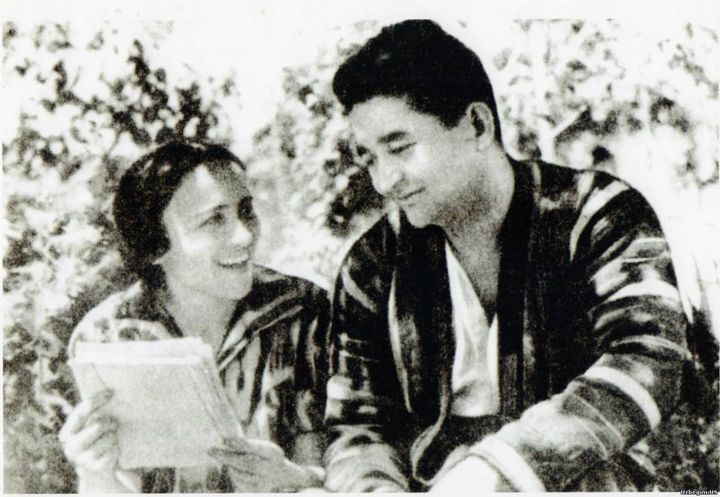
ENG GULLAGAN YOSHLIK CHOG‘IMDA…
Eng gullagan yoshlik chog‘imda, Sen ochilding ko‘ngil bog‘imda.
Shunda ko‘rdi ko‘zim bahorni, Shunda qalbim tanidi yorni.
Qushlar sayrar jonimga payvast, Men sevgining bo‘yi bilan mast.
Kuni bilan dalada qoldim, Lolazorlar ichra yo‘qoldim.
Quchoq-quchoq gullar terganim Va keltirib senga berganim
Kechagiday hamon esimda, Har soniya, har on esimda.
Shundan beri tilimda oting, Shundan beri dilimda oting.
Eng gullagan yoshlik chog‘imda, Sen ochilding ko‘ngil bog‘imda.
(1937-yil)